



The Complete Guide to Brass Jewelry: Why It's the Ultimate Value Champion in Modern Accessories
1. Introduction: The "Gold" Rush of the Rational Consumer
The landscape of modern jewelry consumption is shifting. Gone are the days when value was solely dictated by the carat weight of gold or the purity of silver. Today, particularly among Millennials and Gen Z consumers—who now account for a significant portion of luxury spending—there is a distinct trend toward "de-branding" and "value maximization." Data indicates that over 65% of consumers aged 18-35 prioritize design, durability, and price-to-performance ratio over heritage brand logos.
This behavioral shift has created a vacuum in the market. On one end, solid gold (14K, 18K, 24K) remains prohibitively expensive for trend-driven purchases. On the other hand, low-cost zinc alloys or base metals often exhibit poor structural integrity and rapid degradation. Enter brass: an ancient alloy that has been revitalized as the "hero material" of the democratization of luxury.
Brass jewelry offers a compelling dichotomy: it possesses a natural, warm golden luster indistinguishable from 14K gold to the untrained eye, yet it costs a fraction of the price. It is not merely a cheap substitute; it is a standalone category defined by superior hardness, exceptional workability, and a unique capacity to develop a personalized patina. This guide delves deep into the physics, economics, and artistry of brass, positioning it as the undisputed value champion of the jewelry world.
2. Understanding Brass: The Material Science
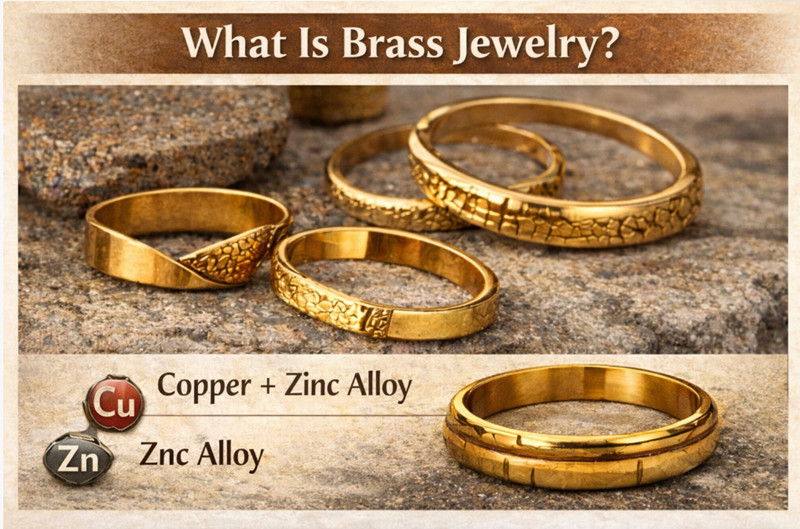
To truly appreciate the value of brass jewelry, one must first understand its metallurgical composition. Brass is a substitutional alloy consisting primarily of Copper (Cu) and Zinc (Zn). Unlike pure metals, the properties of brass can be fine-tuned by adjusting the ratio of these two elements, making it incredibly versatile for jewelry manufacturing.
2.1 The Chemistry of Color and Durability
The color of brass is directly correlated to its zinc content. Higher copper content yields a reddish-gold tone (resembling rose gold), while higher zinc content produces a lighter, brighter yellow (resembling 14K or 18K yellow gold). In the context of professional jewelry manufacturing, three specific grades of brass dominate the market:
| Grade | Composition | Characteristics | Ideal Application |
| H62 | Brass 62% Copper, 38% Zinc | The "Workhorse" Alloy. Balanced hardness and ductility. Excellent polishing properties. | Every day rings, bangles, and foundational DIY components. High cost-performance ratio. |
| H65 | Brass 65% Copper, 35% Zinc | Superior malleability and corrosion resistance. Lighter golden hue | Intricate filigree work, fine chains, and delicate pendants requiring detailed stamping |
| H59 | Brass 59% Copper, 41% Zinc | Highest hardness, high tensile strength. Less malleable. | Structural components, chunky industrial-style rings, clasps, and machined parts. |
2.2 Physical Properties Advantage
Beyond its chemical makeup, the physical properties of brass make it uniquely suited for accessories:
Hardness: Brass registers between 3 and 4 on the Mohs hardness scale. This places it above pure silver (2.5) and pure copper (3), meaning it is significantly more resistant to scratches, dents, and deformation during daily wear. A brass ring will maintain its circular shape far longer than a pure silver equivalent under similar stress.
Acoustics & Density: Brass has a density of approximately 8.4–8.7 g/cm³. This gives it a "heft" and tactile quality similar to precious metals, avoiding the lightweight, plastic-like feel of cheaper aluminum or tin alloys. When struck, it produces a resonant sound, a subtle indicator of quality metalwork.
Non-Ferrous Nature: Brass is non-magnetic. This is a crucial quick test for buyers to distinguish solid brass from cheap steel-core-plated items.
3. The Value Proposition: The "Quadrilateral of Value."
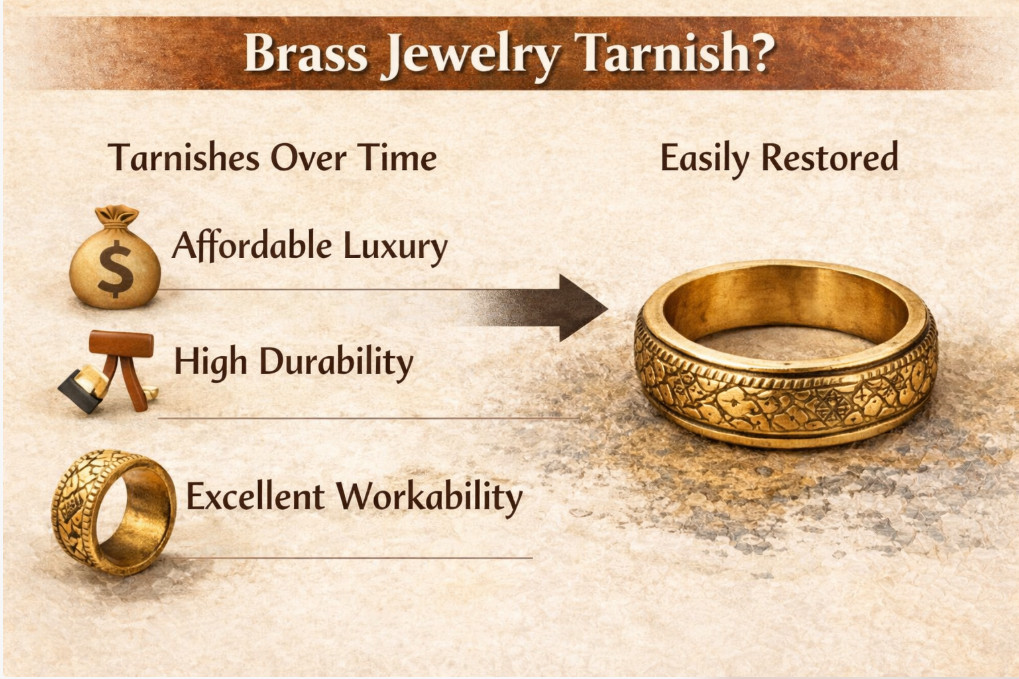
Why is brass crowned the "King of Cost-Performance"? The answer lies in four distinct dimensions where it outperforms competitors: Aesthetics, Durability, Economics, and Wearability.
3.1 Aesthetic Value: The "Living" Finish
Brass is often referred to as a "living metal." While it mimics the look of 14K gold when polished to a mirror finish, its true beauty lies in its interaction with the environment. Unlike plated jewelry that looks worse as it ages (revealing a grey or coppery base), brass ages gracefully.
Over time, raw brass develops a natural oxidation layer known as patina. This creates a spectrum of colors from warm honey to antique bronze and deep, earthy browns. For vintage and heritage-style brands, this self-antiquing property is a feature, not a bug. However, for those who prefer the high-shine look, restoring brass is simple and endless—a quick polish returns it to its original state, unlike plated jewelry, which, once stripped, is ruined forever.
3.2 Economic Value: Manufacturing & Retail Margins
From a B2B perspective, brass is an economic powerhouse. Copper and Zinc are abundant resources, keeping raw material costs relatively stable and low compared to the volatile precious metal markets.
Cost Comparison (Estimated Raw Material Ratios):
Solid 14K Gold: 100x Cost Baseline
Sterling Silver (925): ~2-5x Cost Baseline
Solid Brass: ~0.1x Cost Baseline
This massive reduction in material cost allows designers to allocate budget towards craftsmanship rather than raw weight. A consumer can purchase a brass piece featuring complex hand-carving or stone setting for $50, whereas a similar design in gold would cost upwards of $800. This lowers the barrier to entry for high-design fashion.
3.3 Durability Value: Heirloom Potential
There is a misconception that "affordable" means "disposable." Brass defies this. Archaeological digs frequently uncover brass and bronze artifacts from Roman and Chinese antiquity that are structurally intact. Because brass is solid through-and-through (not plated base metal), it does not chip or flake. A solid brass cuff bought today can, in theory, be polished and worn by the next generation, giving it a sustainability profile that rivals precious metals.
4. Craftsmanship & Styles: The Artistry Behind the Alloy
Brass is a dream material for artisans. Its specific combination of malleability (ability to be hammered into sheets) and ductility (ability to be drawn into wire) allows for a vast array of manufacturing techniques.
4.1 Core Manufacturing Techniques: From Raw Material to Finished Jewelry
The creation of a brass jewelry piece involves multiple stages, including design, material cutting, forming, engraving, soldering, polishing, and surface finishing. Each step requires precision, experience, and craftsmanship.
Basic Techniques
Cutting: Brass sheets or wires are cut into rough shapes using tools such as jeweler’s saws or angle grinders, forming the initial blank.
Forming: Hammers, anvils, and bending tools are used to shape the metal, such as creating ring bands or the curvature of bangles.
Sanding: The surface is gradually refined using sandpaper ranging from coarse (around 80 grit) to ultra-fine (up to 2000 grit) to remove burrs, scratches, and imperfections.
Polishing: Polishing cloths or mechanical polishers are applied to achieve a smooth, glossy finish.
Advanced Techniques
Filigree Setting: Fine brass wires are twisted into intricate patterns and fixed onto a base structure, creating delicate openwork designs.
Engraving (Chasing & Repoussé): Specialized chisels are used to hand-strike the brass surface, forming raised or recessed decorative patterns.
Hollow Carving: Openwork designs are achieved through laser cutting or meticulous hand carving, enhancing depth and visual lightness.
Electroplating: A layer of gold, silver, or nickel is plated onto the brass surface to improve oxidation resistance and enhance visual appeal.
Specialty Finishing Techniques
Chemical Antiquing: Solutions such as potassium sulfide or ammonia are applied to rapidly oxidize the surface, creating a vintage patina. Excess oxidation is then selectively removed to highlight engraved details.
Physical Distressing: Partial sanding or sandblasting is used to produce a matte, aged appearance with a handcrafted feel.
Controlled Oxidation: By adjusting oxidation duration and cleaning methods, artisans can create gradient effects or localized patina for distinctive, one-of-a-kind finishes.
Different techniques give brass jewelry its wide range of textures and styles. Basic processes result in clean, versatile designs; advanced techniques deliver refined and intricate craftsmanship; while specialty finishes provide bold individuality—allowing brass jewelry to meet diverse aesthetic and market demands.
4.2 Stylistic Versatility
The adaptability of brass has led to its adoption across divergent fashion subcultures:
The Neo-Vintage Movement: Brands utilizing chemical oxidation to artificially age brass, creating "relic" pieces that pair perfectly with denim and leather.
Modern Minimalist: High-polish, geometric brass jewelry that serves as a gold alternative for corporate and formal wear.
Brutalist & Industrial: Leveraging the raw, machined look of H59 brass to create heavy, architectural statement pieces.
5. Buying Guide: How to Select and Maintain Quality
For retailers stocking their shelves or consumers building their collection, discerning quality is paramount. Not all brass is created equal.
5.1 How to Choose Quality Brass Jewelry: Three Key Criteria to Avoid Common Pitfalls
The quality of brass jewelry on the market varies widely. To avoid low-quality products, buyers should focus on the following three key criteria when making a purchase:
Material Identification
It is essential to distinguish solid brass from imitation materials such as copper-plated steel or aluminum alloy.
Weight Test: Brass has a relatively high density. For the same volume, solid brass feels noticeably heavier and more substantial than copper-plated steel or aluminum alloy.
Color Observation: Genuine brass has a warm, soft golden tone. Imitation materials often appear overly bright, artificial, or have a cold metallic hue.
Magnet Test: Brass is non-magnetic. If a piece is attracted to a magnet, it is likely made from copper-plated iron rather than solid brass.
Craftsmanship Quality
High-quality brass jewelry is carefully finished, with smooth surfaces free of burrs or scratches. Soldered joints should be clean and secure, with no visible gaps or residue. Decorative patterns should be sharp and well-defined, and edges should feel smooth to the touch.
Lower-quality pieces may have rough edges, weak soldering, or blurred details—issues that affect both appearance and long-term durability.
Anti-Oxidation Treatment
It is recommended to choose brass jewelry with protective treatments such as a clear lacquer coating, wax finish, or electroplating. These treatments help slow oxidation and reduce the need for frequent maintenance.
If you prefer untreated solid brass jewelry, be prepared to perform regular care and cleaning to maintain its appearance.
5.2 Wearing and Care Tips: How to Keep Brass Jewelry Looking Its Best
The key to maintaining brass jewelry is minimizing exposure to air, moisture, sweat, and chemicals. Proper care ensures long-lasting beauty and performance.
Daily Wearing Guidelines
Avoid wearing brass jewelry while swimming, bathing, or exercising to prevent prolonged exposure to water and perspiration.
Apply perfume, cosmetics, or sunscreen first and allow them to fully absorb before putting on jewelry to prevent chemical damage.
Remove jewelry before sleeping to avoid deformation from pressure or friction-related oxidation.
Cleaning Methods
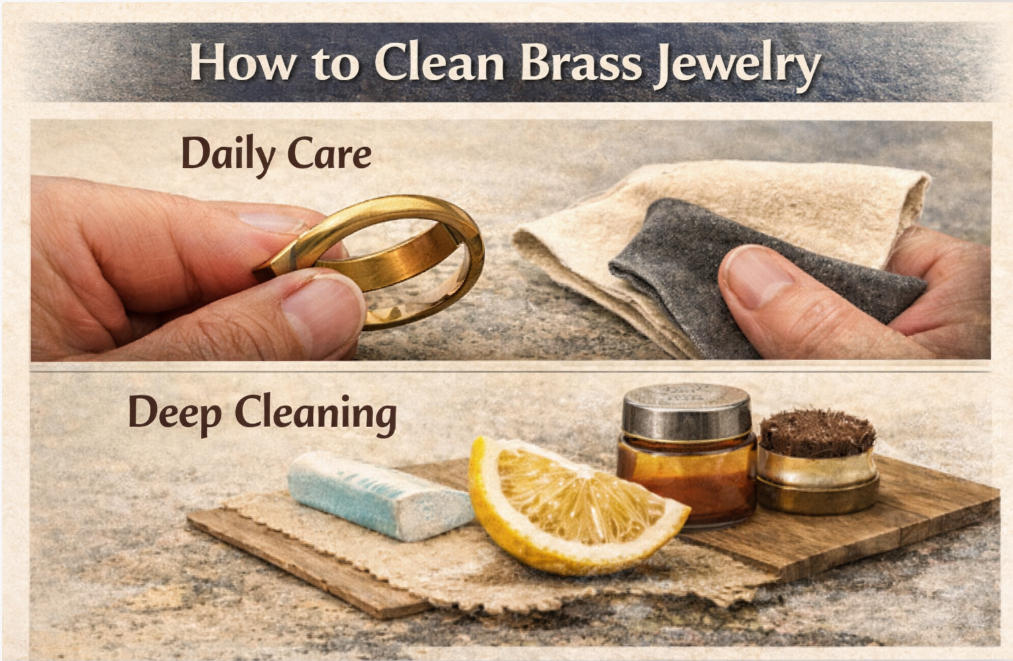
For daily care, gently wipe the surface with a soft cloth (such as a microfiber or jewelry polishing cloth) to remove dust and sweat.
For light tarnish, mix a small amount of non-abrasive toothpaste with water, then gently rub the surface with a soft cloth. Rinse with clean water and dry thoroughly.
For heavy oxidation, use a professional brass cleaner (such as a citric-acid-based solution or specialized polishing paste) according to the product instructions. After cleaning, dry the jewelry completely and apply a thin layer of protective wax if desired.
Long-Term Storage
When not in use, wipe the jewelry clean and dry with a soft cloth. Store it in a sealed bag or an airtight container with 1 or 2 packets of desiccant to limit exposure to air. Avoid storing brass jewelry alongside other metal pieces to prevent scratches from friction.
6. Market Trends: The Future is Golden (Brass)
The trajectory of brass jewelry points upward, driven by macroeconomic factors and evolving tastes.
6.1 The Sustainability Driver
Brass is highly recyclable. The scrap brass from the jewelry industry is melted down and reused with almost zero loss of quality. In a world increasingly conscious of the environmental toll of gold mining (which involves toxic cyanide leaching and massive earth displacement), recycled brass presents an ethical alternative. Brands marketing "Eco-Brass" or "Recycled Ammunition Brass" are gaining traction among eco-conscious demographics.
6.2 The Rise of Independent Brands (DTC)
For independent designers and Drop-Shipping/DTC brands, brass is the ultimate incubator material. It allows small businesses to launch collections with complex custom molds without the capital risk of stocking precious metals. The "Bridge Jewelry" category—positioned between costume jewelry and fine jewelry—is currently the fastest-growing segment, and brass is its backbone.
6.3 Customization and DIY Culture
The accessibility of brass has fueled a Maker Movement. H62 brass sheets and wire are staples in jewelry classes worldwide. This has led to a surge in "Handmade" listings on platforms like Etsy, where the unique imperfections of hand-forged brass are celebrated as markers of authenticity.
7. Conclusion: The Smartest Choice in the Jewelry Box
Brass jewelry represents a convergence of history, utility, and modern economics. It challenges the binary perception that jewelry must either be an expensive investment asset (gold) or a cheap, disposable trinket (plastic/alloy).
For the consumer, it offers the freedom to experiment with bold styles and build a diverse wardrobe without financial strain. For the retailer, it offers healthy margins and a product that—quite literally—stands the test of time. Whether polished to a brilliant shine or allowed to darken into a moody antique bronze, brass proves that true value isn't about the price tag; it's about the enduring quality and the story the metal tells.
As we look toward the future of fashion, where individuality reigns supreme over standardized luxury, brass is not just a substitute for gold—it is the gold standard for the modern, practical, and stylish individual.
Disclaimer: The metallurgical grades (H62, H65, H59) mentioned in this guide refer to standard industrial designations. Jewelry composition may vary slightly by manufacturer. Always verify the specific alloy contents to ensure compliance with local regulations on lead and nickel release.
